
Follicle Monitoring in IVF and Ovulation Induction: Scans, Sizes and Trigger Timing
What happens at follicle monitoring visits during ovulation induction and IVF, how to read follicle sizes, and how clinics decide when to trigger, adjust or cancel.
What follicle monitoring is for
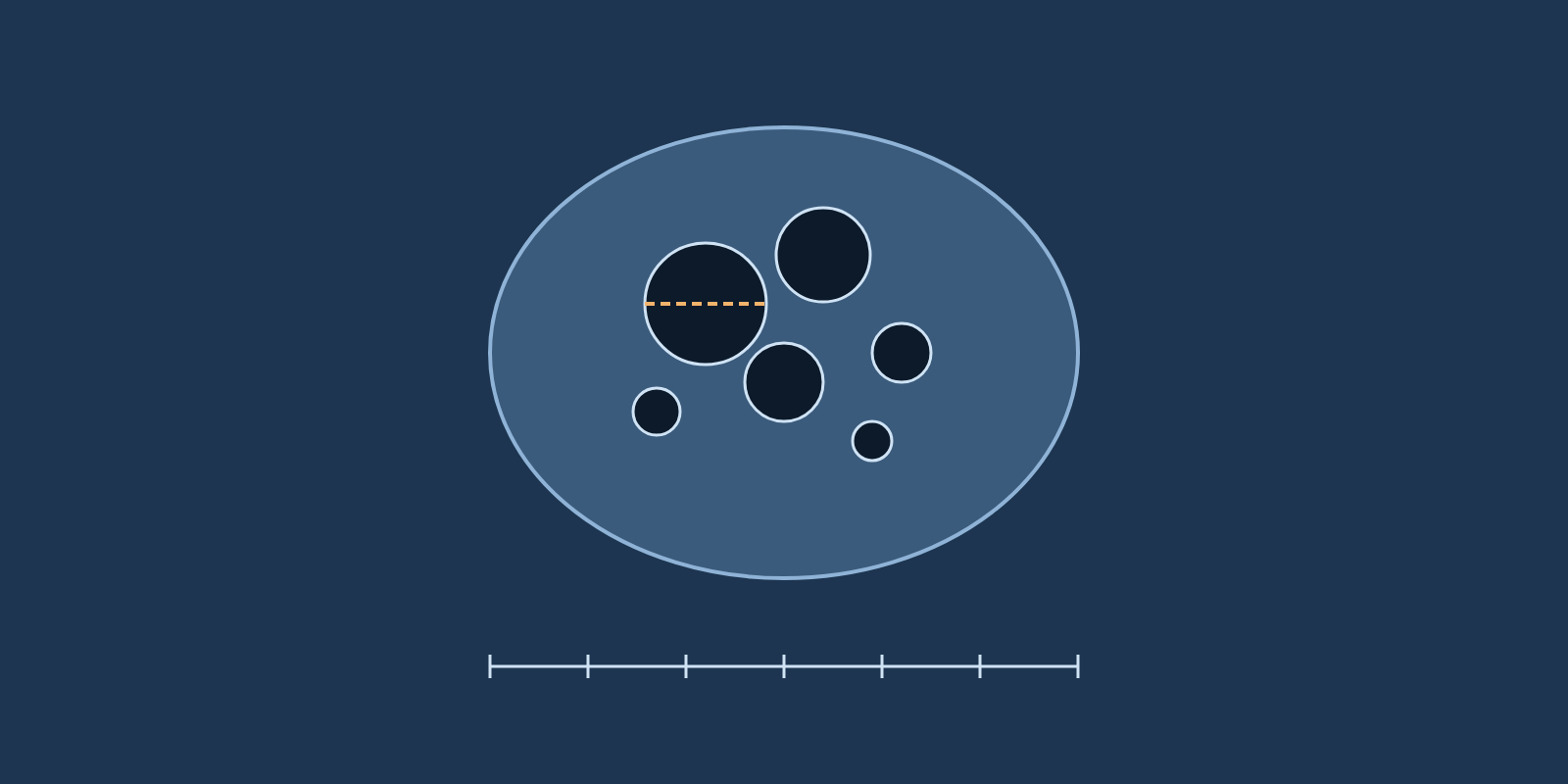
During ovulation induction or IVF stimulation, fertility medications encourage the ovaries to grow follicles. A follicle is the small fluid-filled sac that holds an egg. Follicle monitoring is the series of clinic visits, usually ultrasound scans and sometimes blood tests, that shows how those follicles are responding.
The care team uses the visits to answer three practical questions:
- Is the medication dose working? Too little response may mean the dose needs to change; too much response raises safety concerns.
- When should the trigger shot be given? The trigger starts the final maturation of the eggs, so its timing depends on follicle growth.
- Is it safe to continue? Too many growing follicles can raise the risk of multiple pregnancy or ovarian hyperstimulation syndrome (OHSS).
This guide explains what happens at those visits and what the numbers on your report usually mean. It is general information. Your clinic's plan depends on your diagnosis, the medication protocol and your earlier cycles. For the medications themselves, see our guide to IVF medications and protocols.
Ovulation induction and IVF stimulation have different goals
The same scans are used in two different treatments, but the goal is not the same.
| Ovulation induction (with timed intercourse or IUI) | IVF stimulation | |
|---|---|---|
| Aim | Usually one mature follicle, sometimes two | A group (cohort) of follicles, so several eggs can be retrieved |
| Main safety concern | Multiple pregnancy and OHSS | OHSS; balancing egg number against risk |
| What happens after the trigger | Ovulation, then intercourse or insemination timed around it | Egg retrieval is scheduled before ovulation would occur |
ASRM's committee opinion on gonadotropins for ovulation induction states that the goal in anovulatory women is "the growth and development of a single mature follicle." In IVF, growing several follicles is intended, which is why the same report can look "too high" in one treatment and normal in another.
What happens at a monitoring visit
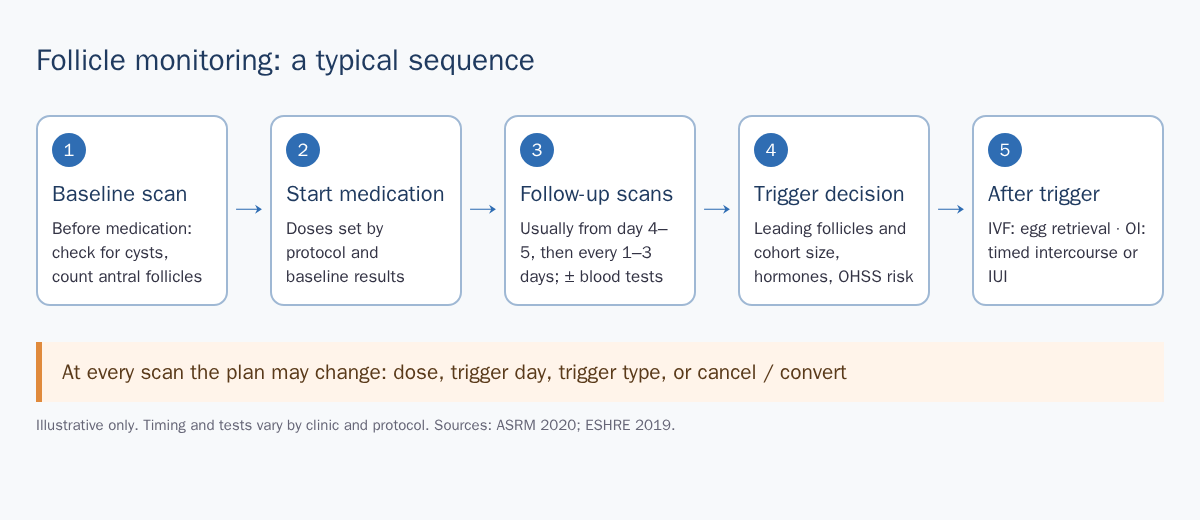
Baseline scan. Before stimulation starts, most clinics do a transvaginal ultrasound to check for ovarian cysts and to count the small resting follicles (the antral follicle count). ASRM notes that baseline ultrasound helps exclude cysts that could be confused with new follicle growth.
Follow-up scans. A transvaginal probe measures each growing follicle, usually in millimeters, and the lining of the uterus (endometrium). For gonadotropin ovulation induction, ASRM describes ultrasound "after the first 4–5 days of treatment and at subsequent intervals of 1–3 days according to response." Visits often become more frequent as follicles approach trigger size.
Blood tests. Many clinics also measure estradiol, and sometimes LH and progesterone. Practice differs here. ASRM's ovulation-induction guidance describes estradiol together with ultrasound as an accurate gauge of response. ESHRE's 2019 guideline for IVF stimulation, by contrast, concluded that adding estradiol to ultrasound monitoring is "probably not recommended," because the studies did not show better pregnancy rates, more eggs or less OHSS. So if your clinic draws blood at every visit and a friend's clinic does not, neither is necessarily wrong. ESHRE has since published an updated guideline; ask your clinic which approach it follows and why.
How to read the numbers
Follicle sizes. Reports usually list each follicle per ovary, for example "R: 18, 16, 14 mm; L: 17, 12 mm." What matters most is the size of the leading follicles and how many are in each size range, not any single number.
Trigger timing. There is no single correct trigger size. ESHRE says the link between follicle size and outcome "has not been sufficiently studied" and that physicians may choose the size case by case. In IVF, its good-practice statement notes that the trigger is most often given when several leading follicles are between 16 and 22 mm, after also considering hormone results, how long stimulation has lasted, past cycles and clinic logistics. ASRM's patient fact sheet notes that in a natural cycle ovulation generally occurs when the follicle measures about 18 to 25 mm (1.8–2.5 cm).
Egg maturity is not the same as follicle size. A large follicle does not guarantee a mature egg, and smaller follicles can sometimes yield mature eggs. Maturity is confirmed only in the lab after retrieval (see egg maturity: MII, MI and GV).
Endometrial thickness. The lining is often measured. ASRM notes it has "some prognostic value," but ESHRE found that endometrial thickness has little ability to predict pregnancy on its own. A single thin or thick reading is something to discuss, not a verdict.
When plans change during monitoring
Monitoring exists so the plan can change. Common adjustments include:
- Dose changes when follicles grow faster or slower than expected.
- Delaying or bringing forward the trigger by a day or two.
- Changing the trigger type when OHSS risk is a concern (for example a GnRH-agonist trigger, where appropriate).
- Cancelling an ovulation-induction cycle or converting it to IVF. ASRM says cancellation should be considered when more than two follicles of 16 mm or larger develop, or three or more intermediate-sized follicles, to limit the risk of multiple pregnancy. Its guidance also notes that multiple follicles as small as 10–12 mm at ovulation can increase that risk.
- Stopping an IVF cycle because of a very low or very high response. Our cycle cancellation and low response checklist explains how to review that decision with your team.
If you develop severe abdominal pain or swelling, rapid weight gain, shortness of breath or reduced urination during or after stimulation, contact your clinic promptly. These can be signs of OHSS (see preventing and identifying OHSS).
Practical tips for monitoring weeks
- Ask what time window the clinic needs you in, and when you will hear the plan for that evening's medication.
- Keep a simple log: date, medication doses, follicle sizes per ovary, lining thickness and any blood results. It makes later cycle reviews much easier.
- Ask the clinic to explain which follicles they are "counting" toward the trigger decision.
- If you are travelling to a clinic, ask whether some scans can be done at a local partner clinic and how results will be shared.
- Clarify whether monitoring visits are billed separately, since costs and insurance coverage vary by plan and state.
Questions to ask your care team
- Is the goal of this cycle one follicle, a few, or a larger cohort?
- How often will I be scanned, and will you also check blood hormone levels?
- What follicle sizes and numbers would lead you to trigger, adjust, or cancel?
- What is my risk of OHSS or multiple pregnancy in this cycle, and what would you change if it rises?
- After the trigger, exactly when is the retrieval, insemination or intercourse timing?
If you are still choosing a clinic, our fertility center directory lets you compare clinics by state, and our IVF egg retrieval guide explains the step that follows an IVF trigger.
References
- Practice Committee of the American Society for Reproductive Medicine. Use of exogenous gonadotropins for ovulation induction in anovulatory women: a committee opinion. Fertility and Sterility, 2020;113(1):66–70.
- ESHRE Reproductive Endocrinology Guideline Group. Ovarian stimulation for IVF/ICSI (October 2019), sections on monitoring and triggering. An update was published later; check the current version on the ESHRE website.
- American Society for Reproductive Medicine, ReproductiveFacts. Ovulation detection (patient fact sheet).
This article is general information and is not medical advice. Discuss your own treatment plan with a licensed fertility specialist.