
IVF Cycle Cancellation and Low Ovarian Response: A Practical Review Checklist
What to review after an IVF cycle is cancelled or egg yield is lower than expected: records to collect, questions to ask and how to compare next steps.
Start with what happened, not a verdict about your future
Hearing that an IVF cycle may be cancelled, or that fewer follicles are growing than expected, can be upsetting. Before deciding what it means, ask the clinic to describe the stage reached and the reason for the proposed change. Stopping stimulation before egg retrieval, retrieving fewer eggs than expected, having no embryo suitable for transfer, and postponing a fresh transfer are different events. They need different review questions.
This guide is for people preparing for a follow-up after a low-response or cancelled stimulation cycle. It explains how to organize records and discuss choices; it does not decide whether an individual should continue, cancel or change treatment. For an overview of the whole treatment pathway, see our IVF process guide.
An important distinction comes from ESHRE's ovarian stimulation guideline, whose current online PDF includes a September 2026 update: low response to ovarian stimulation alone is not a reason to cancel a cycle. The guideline calls for individualized counselling about pregnancy prospects and whether to continue. That is a discussion with the treating team, rather than a rule that every low-response cycle must proceed or must stop.
Clarify the stage and the reason
Ask for the reason in plain language and, if possible, in the written cycle summary. The phrase “the cycle did not work” is too broad to guide the next discussion.
| What the clinic describes | What to clarify at the review |
|---|---|
| Stimulation stopped before retrieval | What monitoring findings led to the recommendation? What were the options for continuing or stopping? |
| Retrieval took place but egg yield was lower than expected | How many follicles were seen, how many eggs were retrieved, and how many were mature? |
| No embryo was available for transfer | What did the fertilization and embryo-development reports show? This is a laboratory-stage review as well as a stimulation review. |
| A fresh transfer was deferred while embryos were frozen | Was this a planned change for timing or safety? This is different from having no embryos available. |
Do not change medication or trigger timing based on a general article. If a cycle is still in progress, obtain instructions directly from the clinic, including whom to contact outside office hours.
Low ovarian response is not the same as low egg quality
Ovarian response describes what happens during stimulation: for example, the pattern of follicle growth and the number of eggs obtained. Ovarian reserve refers to the remaining egg quantity and can be assessed indirectly with tests such as anti-Müllerian hormone (AMH) and antral follicle count (AFC).
ASRM's 2020 committee opinion explains that AMH and AFC are useful for predicting egg yield and ovarian responsiveness. They are much less useful for predicting reproductive potential independently of age. A result cannot, by itself, tell you the quality of every egg or your individual chance of having a baby. ASRM also cautions against using an extremely low AMH result alone to refuse IVF treatment.
For background before your appointment, read our AMH guide and AFC guide. Ask your clinician how your age, history and observed response fit together. Avoid treating one test number or one cycle as a complete prognosis.
Bring a compact cycle record
A useful review starts with the information the team actually used. Request copies rather than trying to reconstruct everything from memory. Keep dates attached to laboratory and ultrasound results so that changes over time are visible.
- Before treatment: your relevant medical and treatment history, baseline ultrasound, and the AMH or other tests used to plan the cycle, with dates and units.
- Medication calendar: the prescribed medicines, doses and dates, any changes, and any missed or uncertain doses you reported. The aim is an accurate record, not assigning blame.
- Monitoring: ultrasound reports and hormone results the clinic obtained, alongside the instructions issued after each visit.
- Cycle decision: the date and documented reason for stopping, continuing or changing the planned next step.
- If retrieval occurred: the retrieval summary, number of eggs obtained, maturity assessment, fertilization method and laboratory report.
- Practical information: itemized charges, any refund or credit terms, remaining medication, time away from work and the support you may need.
Bring a short list of your own priorities. These might include using your own eggs, limiting procedures, understanding financial exposure, taking time to recover, or seeking another opinion. A clinically possible option may still be a poor fit for your circumstances.
Review the gap between expected and observed response
Ask the clinician what response was expected before stimulation and which findings changed that expectation. If a low response had been anticipated, the discussion may focus on whether the observed outcome matched that plan. If the response was unexpected, ask which parts of the record deserve closer review.
It is reasonable to ask about the choice of protocol, medication delivery and administration, monitoring, follicle development and the rationale for any changes. A review does not guarantee that a single correctable cause will be found. It also should not automatically become a list of additional tests: ask what clinical question a proposed test would answer and whether the result would change management.
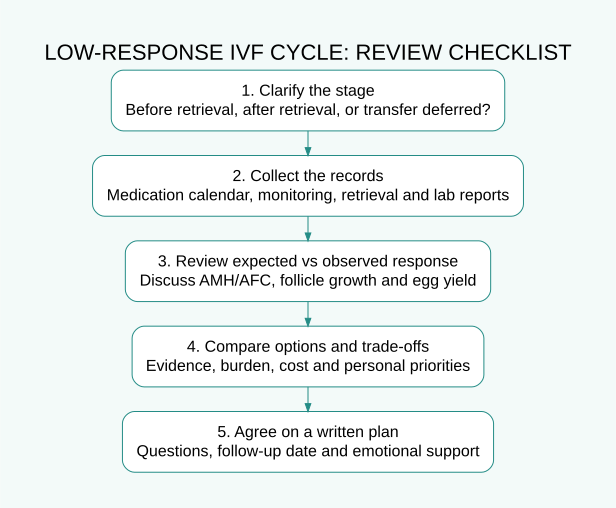
This is an editorial appointment-preparation diagram, not a treatment algorithm or a prediction of outcome.
Compare the next options without assuming more treatment is better
Depending on your circumstances, the conversation may include continuing the current cycle, stopping it, revisiting a stimulation approach for a future attempt, taking a break, or discussing other family-building paths. These possibilities are not interchangeable, and none should be presented as the required next step for everyone.
If a different protocol or medication dose is proposed, ask what specific benefit is expected in your situation and what evidence supports it. More medication does not necessarily produce a better outcome. ASRM's 2018 guideline on mild versus conventional stimulation in poor responders found important limitations in the evidence, including limited live-birth data. It should not be interpreted as proof that one approach is best for every patient; the treating clinician should also consider newer guidance and the details of your cycle.
For any proposed add-on, supplement or additional procedure, ask about the evidence for the outcome you care about, possible harms, extra appointments and total cost. Do not assume that an intervention advertised for “egg quality” will improve live birth. Ask what can reasonably be learned from another attempt and what would remain uncertain.
Ask for a comparison that uses the same denominator
A clinic may describe results per cycle started, per retrieval or per embryo transfer. Those are different populations. A figure per transfer excludes people whose treatment did not reach transfer, so it does not directly answer the same question as a figure per started cycle.
Ask which measure is being quoted, which patients it describes, the data year, whether own eggs or donor eggs were used, and whether the estimate includes more than one transfer. Our success-rate reading guide explains these differences. Population data can help frame a discussion but cannot promise your individual result.
Leave with a written plan and room to pause
Before the appointment ends, write down the agreed next step, what information is still missing, who will obtain it and when you will speak again. If treatment is ongoing, confirm medication instructions directly with the clinic. For a future attempt, ask when planning would begin and what needs to happen first; there is no universal restart date in this article.
Request an itemized estimate for the options being discussed and clarify which services have already been billed. If you want a second opinion, ask for the cycle records and laboratory reports needed for it. You can use the fertility-center directory to identify practices to contact, while independently checking current services and credentials.
A cancelled or disappointing cycle can also bring grief, anger or exhaustion. Ask about counselling or support services if that would help. Taking time to understand the records and your priorities is a valid part of decision-making; you do not have to settle every future choice in one appointment.
References
- ESHRE — Ovarian Stimulation for IVF/ICSI guideline and update information. Current online full guideline PDF includes a September 2026 update; sections on response prediction and criteria for cancellation were checked on November 15, 2026.
- ESHRE — Full ovarian stimulation guideline, September 2026 PDF update.
- ASRM — Testing and interpreting measures of ovarian reserve: a committee opinion (2020).
- ASRM — Comparison of pregnancy rates for poor responders using IVF with mild ovarian stimulation versus conventional IVF: a guideline (2018). This older evidence review is identified by its publication year and does not replace current individual clinical advice.
This article provides general educational information, not medical advice. Discuss your circumstances and treatment decisions with a licensed fertility professional.